
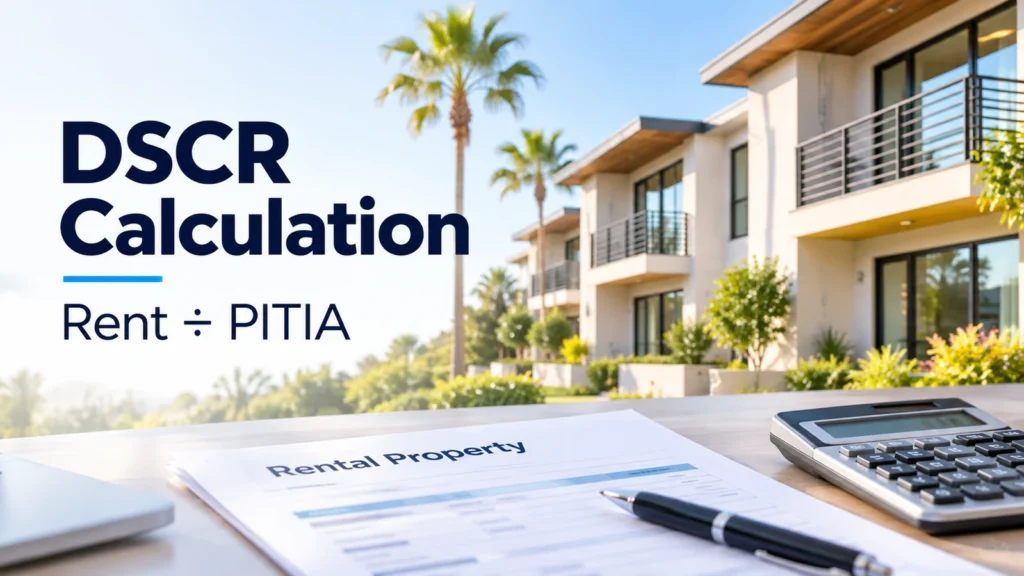
When reviewing a rental property, one question often comes up: How is DSCR calculated? Understanding this ratio can help investors and mortgage brokers evaluate how a property’s rental income compares with its monthly housing payment.
DSCR stands for Debt Service Coverage Ratio. In many residential investment-property loan programs, it is a useful starting point for evaluating a rental property. However, the lender’s final calculation depends on the specific program and acceptable documentation.
What Does DSCR Measure?
DSCR compares a property’s qualifying income with the payment it is expected to support.
A ratio of 1.00 means the qualifying rent equals the monthly housing payment used in the calculation. A ratio above 1.00 means the rent exceeds that payment; below 1.00 means it falls short.
That does not necessarily tell you whether the investment is profitable. Repairs, vacancies, management fees, utilities, and other operating costs may still affect actual cash flow.
Also, do not confuse the residential mortgage approach with the net operating income divided by debt service formula often used in commercial-property analysis. The definition and inputs depend on the financing context.
How Is DSCR Calculated? Rent Divided by PITIA
For many residential DSCR mortgage programs, a common approach is:
DSCR = Eligible Monthly Rental Income / Qualifying Monthly PITIA
PITIA generally includes the following monthly expenses:
- P: Principal payment
- I: Interest payment
- T: Property taxes
- I: Property insurance
- A: Association dues, when applicable
The rental-income figure may come from an eligible lease, appraiser-supported market rent, or other documentation allowed by the program. The lender determines which income can be counted and which qualifying payment should be used.
Using only principal and interest in the denominator can overstate the result because taxes, insurance, and applicable dues also matter.
A Simple DSCR Calculation Example
Suppose a rental property has $2,700 in eligible monthly rent. Its estimated qualifying payment consists of $1,650 in principal and interest, $350 in property taxes, $150 in insurance, and $100 in association dues.
Those amounts total $2,250 in monthly PITIA.
$2,700 / $2,250 = 1.20 DSCR
In this illustration, the rent equals $1.20 for every $1.00 of qualifying monthly housing expense. That is a measurement of payment coverage, not a guarantee of positive cash flow or loan eligibility.
If the accepted rent or qualifying payment changes during underwriting, the final ratio may change too.
Why the Lender’s DSCR May Be Different
An investor’s initial calculation is often based on advertised rent and estimated costs. A lender may need different figures.
For example, acceptable rent may depend on the current lease, an appraisal or rental schedule, property occupancy, and the program’s treatment of short-term rentals. A projected rent increase may not be eligible simply because the owner expects to charge more.
The payment side can change as well. Property tax estimates, insurance premiums, association dues, and the applicable loan payment must be accurate. Interest-only structures may have their own qualifying-payment rules.
Even a modest adjustment to rent or PITIA can move the ratio. That is why an early DSCR estimate should be treated as preliminary rather than as an underwriting decision.
What If the DSCR Is Below 1.00?
A DSCR below 1.00 does not necessarily mean that every financing option is unavailable.
Pacific Bay Lending Group offers flexible Non-QM DSCR options for eligible investment-property scenarios. Depending on the program, borrowers may have options with a DSCR below 1.00 or even a No Ratio DSCR structure when the property’s qualifying rental income does not fully cover the monthly housing payment.
These options can provide additional flexibility for certain investment-property scenarios, but they remain subject to applicable credit, loan-to-value, reserve, property, and other program requirements.
For more information, see our guide to What Is a DSCR No Ratio Loan?
What Should Investors Check Before Applying?
Before discussing an investment-property loan scenario, gather a realistic rent estimate and a complete monthly property-payment breakdown. If available, compare existing leases with local rental evidence, and confirm the current tax, insurance, and association amounts.
Remember that DSCR is only one part of a loan review. Credit profile, property type, loan-to-value ratio, assets, occupancy, and other eligibility requirements may also apply, depending on the program.
For a broader introduction, see our DSCR Loans article and Non-QM Loans overview.
Contact Pacific Bay Lending Group to discuss your rental-property scenario and the options that may be available, subject to applicable program requirements.